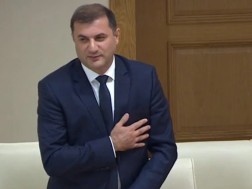


Tbilisi (GBC) – The Constitutional Court of Georgia has rejected a motion filed by representatives of the respondent opposition parties to recuse the full bench (plenum) of judges. This decision was announced by the Chairman of the Constitutional Court, Revaz Nadaraia, upon his return from the deliberation room.
During the proceedings, some representatives of the respondent side requested the recusal of the entire bench, while others sought the recusal of specific individual judges. Ana Tsitlidze, a representative of the "Unity - National Movement" party, stated that the lawsuit in question is aimed not only at banning opposition political parties but also at undermining the sovereignty and freedom of Georgia. Representatives of the plaintiff, "Georgian Dream," opposed the recusal motion, following which the court retired to deliberate. Following the rejection of a motion, the substantive review of a lawsuit filed by the ruling team has officially begun in the Constitutional Court. The lawsuit seeks to have five opposition parties declared unconstitutional, banned, and their registrations revoked. The case is being heard by the Plenum of the Constitutional Court, composed of seven judges. Substantive hearings are scheduled for October 21, 22, and 23.
The lawsuit submitted to the Constitutional Court is signed by 88 members of the 11th convocation of Parliament. Based on this filing, the Court is tasked with considering the potential declaration of unconstitutionality and the banning of the following five political entities:
- "Unity – National Movement";
- "Coalition for Change – Gvaramia, Melia, Girchi, Droa";
- "Strong Georgia – Lelo, For the People, For Freedom!";
- "Federalist Party";
- "The party "Gakharia for Georgia."
Arguments of the Plaintiffs and the Conclusion of the Temporary Investigative Commission
Attached to the constitutional lawsuit is the conclusion of a temporary investigative commission established within the 11th convocation of Parliament. According to the plaintiffs, the named political entities have, since 2016—in a virtually continuous manner—rejected the political legitimacy of Georgia’s incumbent government and the ruling party, both in terms of domestic and foreign policy. The authors of the lawsuit assert that these parties have operated for years as a unified coalition, engaging in unconstitutional actions, including acts of sabotage against the state.
The lawsuit cites the formation of an "Opposition Alliance" on March 2, 2026—intended for "joint work to achieve common goals"—as a recent example of this coalition. The plaintiffs point out that a declared principle of this alliance is the rejection of the legitimacy of elected bodies and public officials. Furthermore, the lawsuit highlights platforms established through the mediation of former President Salome Zourabichvili, as well as the cooperation between the "ENP" [United National Movement] and the party "Gakharia for Georgia" within the municipal councils (*sakrebulo*) of Chkhorotsqu, Tsalenjikha, Rustavi, Zugdidi, and Senaki following the 2021 local self-government elections. Furthermore, the lawsuit notes that although other small or fictitious parties are closely linked to the aforementioned entities (for example: "Elene Khoshtaria – Droa," "Yes to Europe – Strategy Agmashenebeli," "European Georgia," "Republican Party," "Freedom Square," "National Democratic Party," "Girchi – More Freedom," etc.), there is currently no apparent necessity to ban them, as they do not exert any substantial influence on politics; however, the question of their unconstitutionality may arise at a later stage.
Human Rights Violations and the August 2008 War
A significant portion of the lawsuit is dedicated to the period of the "United National Movement’s" governance from 2004 to 2012. According to the plaintiffs, a system involving the torture and inhumane treatment of inmates within penitentiary institutions was established and developed during this period. The lawsuit states that fundamental rights guaranteed by the Constitution and the European Convention on Human Rights have been violated—including the rights to life, health, privacy, property, and media freedom.
Furthermore, the lawsuit focuses on the 2008 Russo-Georgian War and related events. The MPs assert that, during its time in power, the "National Movement" systematically carried out actions that facilitated the occupation of Georgian territories and strengthened the political position of the occupying force.
The plaintiffs claim that between 2019 and 2025, there were six direct attempts to overthrow the constitutional order of Georgia and alter it through violence. Consequently, the authors of the lawsuit, signed by 88 MPs - are requesting that all five named political parties be declared unconstitutional, that their activities be banned, and that their registration in the Public Registry be revoked.
Proceedings in the Constitutional Court are currently ongoing.