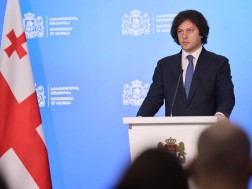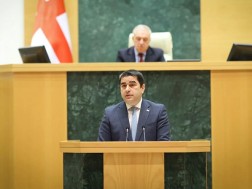


Tbilisi (GBC) - “We will actively engage with representatives from distribution companies and market chains to secure reductions in prices for our fellow citizens. If necessary, we will also utilise antitrust mechanisms that have proven effective in various countries,” stated Georgian Prime Minister Irakli Kobakhidze in a video message addressing consumer prices.
The Prime Minister urged law enforcement agencies to conduct a thorough investigation into the matter.
“I call on law enforcement agencies to examine the issue in detail and determine whether there are any indications of criminal activity by specific entities.
Additionally, I would like to request that the Georgian Parliament establish a parliamentary commission, empowered to utilise relevant parliamentary tools to assess and address this issue,” Irakli Kobakhidze added.
The Prime Minister also mentioned in his video address that the disparity between Georgian and European prices is quite significant.
“When comparing identical international brand products in Georgia and France, sunflower oil is 34% more expensive in Georgia, pasta 97% more, rice 180% more, butter 30% more, cheese 42% more, and chocolate 47% more,” the Prime Minister stated.
According to the Head of Government, the price difference is determined by the high mark-ups of distribution companies and supermarkets, which average 86% from the Georgian border to the checkout.
“The public frequently expresses concern that food prices in Georgian supermarkets are significantly higher than those in Europe. To investigate this issue, we selected several basic food items, compared their prices in Georgia with those in specific European countries, and analysed the markup structures, including the trading practices of chain supermarkets. The disparity between Georgian and European prices is indeed considerable; for example, when comparing identical international brand products between Georgia and France, sunflower oil is 34% more expensive in Georgia, pasta 97% more, rice 180% more, butter 30% more, cheese 42% more, and chocolate 47% more. This price gap is largely driven by high mark-ups applied by distributors and supermarkets, which average around 86% from the Georgian border to the point of sale,” Kobakhidze stated.
Georgia’s Prime Minister also observed that the net profit margins for certain retail chains in Georgia are 7%, 8%, and even 14%, whereas the average net profit margin across Europe is around 2%. According to the Prime Minister, the mark-ups on products and the financial burdens placed on suppliers are so significant that it is often more profitable for Georgian producers to export their goods abroad rather than sell them in Georgian supermarkets.
“Research indicates that the financial profits of chain supermarkets in Georgia are significantly higher than those of their European counterparts. Specifically, net profit margins for certain retail chains in Georgia are 7%, 8%, and even 14%, whereas the average net profit margin across Europe is around 2%. It is also important to note that operating costs for supermarkets in Europe, such as premises rental, labour expenses, utility bills, and so forth, are substantially higher. Additionally, the net profit margins of distribution companies in Georgia are quite high, typically ranging from 6% to 13.5%.
The mark-ups on products and the financial burdens placed on suppliers are so significant that it is often more profitable for Georgian producers to export their goods abroad rather than sell them in Georgian supermarkets. This is why one frequently encounters foreign products in Georgian supermarkets that were actually exported by Georgian companies. This presents a serious problem, as the state’s interest should, on the contrary, be to support Georgian manufacturing and minimise imports as much as possible,” the Prime Minister remarked.
The Head of Government further stated that, amid high profit margins, companies are rapidly expanding their retail networks. Over the past five years, the number of chain supermarkets in the country has doubled. As a result, Georgia now has 113 supermarkets per 100,000 people, compared to 45 in Germany and 62 in Austria. The Prime Minister sees it as reasonable to conclude that the costs associated with network expansion are directly reflected in product prices. According to Kobakhidze, preliminary analyses indicate several key factors that may be contributing to high mark-ups and, consequently, elevated prices.
“For example, there is the so-called network cashback, entrance fees imposed for shelf space, delayed payments to distributors or manufacturers, the proliferation of shops and the reflection of new shop opening costs in prices, and so forth. Most importantly, existing practices raise suspicions that market players may be acting in concert, following cartel principles, which, naturally, requires further analysis,” the Prime Minister noted.
Two-time former Prime Minister Irakli Gharibashvili, accused of corruption, stated in February 2023 that prices and margins for importers and specific rules for retail would be established to regulate food prices.
The rules for the retail sector in Georgia are not approved in Europe, so the Ministry of Economy was to prepare a draft law on fair trade to regulate retail trade rules on the instructions of Gharibashvili.
"The picture that emerged is this - the markup of importers has increased by 100% in some cases, this is unacceptable and the issue must be regulated," Gharibashvili said.
At the request of Gharibashvili, the National Competition Agency studied the market of 7 main products (rice, buckwheat, pasta, sugar, salt, oil, butter), as a result of which it concluded that price increases at the import level were indeed high, although no cartel agreement or violation of the law was officially confirmed. The agency only addressed the business with recommendations.