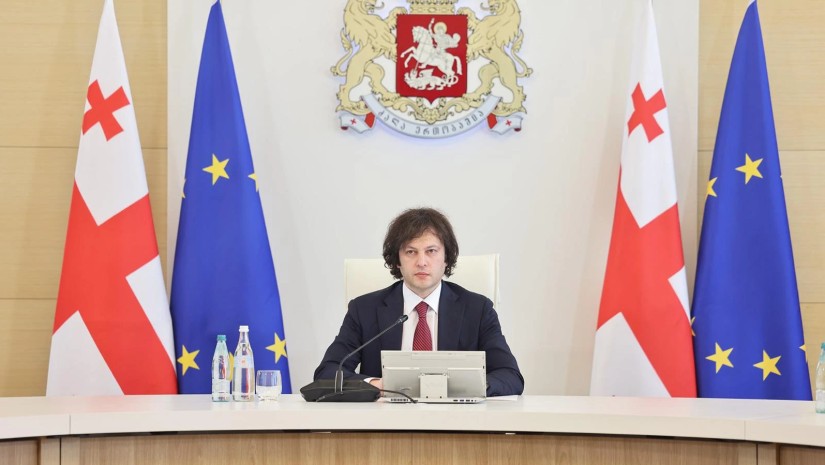

Tbilisi (GBC) – Georgian Prime Minister Irakli Kobakhidze spoke about the current economic and political situation in Germany and stated that the country’s government lacks sufficient resources and sovereignty to manage processes properly.
“The situation in Germany is quite difficult in terms of economy. Over the past three years, a recession has been observed overall, that is, a decline in the economy. All this naturally affects the mood of the population. Everyone sees that the government does not have the resources to manage processes properly, they do not have sufficient sovereignty for this,” Kobakhidze told journalists in Batumi.
According to the Prime Minister, the economic situation in Germany is also reflected in the mood of the country’s voters, and one of the manifestations of this is the elections held in the state of Saxony-Anhalt.
“This is reflected in the fact that the opposition party won in one of the federal subjects, the state of Saxony-Anhalt,” he said, noting that he does not intend to interfere in the choice of the German people.
What do economic statistics show?
Part of Kobakhidze’s statement concerns the dynamics of the German economy in recent years. According to official statistics, Germany’s real GDP decreased by 0.9% in 2023 and by 0.5% in 2024. In 2025, the economy showed growth of 0.2%. Accordingly, the assessment of the entire period of the last three years as a “recession” is not accurate, although the German economy shrank for two consecutive years in 2023-2024.
Amid economic difficulties, the German government is trying to stimulate growth. Chancellor Friedrich Merz has set a target of at least 1% economic growth by 2027, while the current forecast by the Ministry of Economics is for 0.5% growth by 2026.
Saxony-Anhalt elections and AfD victory
Kobakhidze described the results of the Saxony-Anhalt elections as a victory for the opposition, although the AfD – the Alternative for Germany – party that came first in the elections is not a typical opposition force in the country’s political spectrum.
In the September 6 elections, the AfD received around 44% of the vote, achieving an unprecedented result for a German far-right party in regional elections since World War II. The ruling CDU received around 17%. Despite its victory, the AfD does not have an absolute majority, and the issue of coalition partners to form a government remains a problem.
Speaking about the results of the German elections, Kobakhidze stated that "they should draw their own conclusions about the rest" and that Georgia does not intend to interfere in the choice of the German people.